Showing posts with label Mandar. Show all posts

Wednesday, October 1, 2014

Sayang Sayang - Guitar Music of West Sulawesi


[Aural Archipelago has moved to a new site - why not read this article there? Lots more material at www.AuralArchipelago.com]

Location: Outside Tinambung, Mandar Regency, West Sulawesi

Sound: Sayang sayang

When it comes to traditional music here in Indonesia, it can often be hard to get the facts straight, even if you ask the musicians themselves. There is little information about the origins of sayang sayang, a style based around the uniquely fingerpicked guitar played by the Mandar people of West Sulawesi. The name itself comes from the typical refrain of a sayang sayang song - "sayange, sayange!" (Darling, darling! in the Mandar language.)

Other than that, things get sketchy. The musicians I met said it all started when the Spanish brought guitars to Sulawesi more than a hundred years ago. But wait a second, the Spanish? The Portuguese all well-known to have spread the guitar around the archipelago, while the Spanish mostly stayed away from the colonies. Nonetheless, the musicians were adamant- it was the Spanish.

Next, how did such a style emerge? All it takes is an open ear and a decent knowledge of Indonesian music to hear similarities to the hybrid Portuguese-Indonesian kroncong music of Java, with it's rhythmic string instruments and syncopated basslines. Did sayang sayang come from kroncong, I asked? No, no...no connection, they said. The style, they said, started spontaneously in the beginning of the 20th century. But one of the main songs/picking styles of the sayang sayang reportoire (and the song I share with you here) is called "Kemayoran", also the title of a well known kroncong song, named after a neighborhood of Jakarta! It must be a coincidence, they said. After some confused queries, the group leader was willing to concede that their bass player may have individually been influenced by kroncong basslines, but no more than that!

These days, I was told, all sayang sayang groups have gone electric to better accommodate the large wedding parties and other gigs - gone are the days of acoustic guitar (what they call gitar angin - literally wind guitar.) A typical group consists of two electric guitars - one strumming rhythmic cords, while the other melodically fingerpicks - one bass and at least two singers, preferably a man and a woman. The fingerpicked guitar is the true heart and soul of the music - sayang sayang music is even categorised not by song, per se, but by picking style or pattern - there are, according to the group we met, around eight picking styles/patterns in all, each requiring a unique tuning.

While the intricate picking style may be my favorite aspect of sayang sayang, surely the most unique ingredient is the singing - the male and female vocalists trade off improvising lyrics about the audience in a stream of consciousness designed to get folks to come up to the stage and throw down some bills for the musicians. This back and forth, because of its improvised nature, can stretch sayang sayang songs into all-night affairs - the group I met bragged that sayang sayang music features the longest songs in the world -sometimes hours and hours of endlessly looping instrumental parts and refrains.

Context: 

Just like Batang Hari Sembilan, I first heard the Mandar guitar music of sayang sayang on the amazing Indonesian Guitars album from the legendary Music of Indonesia series recorded and curated by my ethnomusicological hero, Philip Yampolsky. Yampolsky and his crew had headed out to Mandar in the nineties and laid down some great tracks (acoustic, interestingly enough!), but as far as I know, no other foreigners had bothered to head out to those parts and look for more. The Mandar regency is an obscure corner of a massive island more famous for the death-obsessed Torajans of the south and the world class diving of Bunaken in the Nortth - few people make the trek to experience a hot, steamy coastal fishing area with no tourist attractions other than sailboats.


What Mandar is missing in concrete tourist destinations, it more than makes up for in rich cultural heritage. The Mandar are a proud people, and they've stuck to their culture and music more than most ethnic groups that I've met in Indonesia. It was surprisingly easy to meet a sayang sayang group - my friend Asep (who later introduced me to Cigawiran music in Garut) introduced me to the group Siasayangngi, said to be one of the best in the area.

After stopping by unannounced at the leader's wooden stilted house, the group's leader kindly invited us to record them a few days later in his living room. Coming on schedule at the appointed time, we felt the disorienting affects of what Indonesians call jam karet - rubber time, the flexible approach to time found all across the archipelago. After a few hours sitting on the wooden slats of the living room floor, munching on cookies and listening to chickens fight down below, the group had been assembled.

As the band played, sound booming through the too-large soundsystem in the cramped living room, the mic was passed back and forth between the singers while the singers traded off improvising lyrics about Asep and me. As they were singing in the Mandar language, I didn't catch much more than "Amerika" and the Indonesian phrase kaca mata (glasses), but it was later translated roughly for me as something along the lines of "Hey there, American guy, hey guy in the glasses! Welcome to Mandar, we hope you enjoy it! Please marry a Mandar woman and settle down here!" It was a moment I'll never forget - sitting in that living room, listening to this delightful music that just so happened to be all about me!

Thursday, August 21, 2014

Music of Mandar, Pt. 1: Gongga Lawe


[Aural Archipelago has moved to a new site - why not read this article there? Lots more material at www.AuralArchipelago.com]

Location: Tinambung, West Sulawesi

Sound: Gongga lawe (also called gongga labe or jarumbing)

As part of my work in collaboration with the Indonesian Mouth Harp Association (Asosiasi Harpa Mulut Indonesia), I've tried to seek out as much mouth harp music as I can throughout this great archipelago. For an enthusiast of the buzzing, earthy sound of the mouth harp, Indonesia is a wonderland: there are dozens of varieties scattered across the islands, taking myriad forms and connected to varying traditions.

After seeking out the karombi of Tanah Toraja, I headed towards the sunbaked coastal area called Mandar, home to the only other mouth harp tradition in South or West Sulawesi that I'm aware of. In form and function, the gongga lawe is almost identical to the Torajan karombi and a number of other string-pulled mouth harps around Indonesia. For a description of the form and playing technique, you can check out my description in the karombi post linked above.

Gongga lawe has not reached the level of revitalization of other Mandar folk instruments like calong, nor does it have the mystical, socially significant role of the Mandar kecaping. Like many other Indonesian mouth harps, gongga lawe is as much as simple diversion as it is a musical instrument: it was traditionally played, like the calong, as a way for Mandar farmers to amuse themselves while taking a break from the heat and toil of labor in the crops.

These days, very few people can still play gongga lawe, largely because such traditions have been left by the wayside in the face of a progressively modernising society. As usual, I was delighted to meet a craftsman and player of this instrument, as its future, like so many traditional musics, is in jeopardy.

Context:

The main inspiration for my trip to Mandar was this YouTube video highlighting a variety of Mandar musical instruments, including the gongga lawe. Excited by the find, I shared the video with my friends in the Indonesian Mouth Harp Association, who despite their meticulous cataloguing, knew nothing of the instrument. It seemed to me like a challenge: I had to go there.

A few months later, I found myself in Mandar, meeting with Muhammad Ridwan, the uploader of the YouTube video. An expert in traditional Mandar culture, Mas Ridwan hooked me up with some friendly local artists who helped me get in contact with Ka Musa, the gongga lawe player in the video.

When we first stopped by the wooden stilted home of Ka Musa, we found that he was not home at all, as he was out working in the fields. Ah, I thought, my narrative of crushing modernity in Mandar is being complicated!


We came back the next day and I was happy to find Ka Musa greeting us at the tiny portal. Wrapping a sarong below his red t-shirt and peci cap, Ka Musa proudly showed us his assortment of instruments, from the calong to gongga lawe and the related gongga lima. He proceeded to sit humbly on the planks of the wooden floor and share them with me. The gongga lawe he had made himself - later he showed me his method, carving the thin instrument from a long piece of bamboo. Just as Ka Musa was proud, I too was honored to meet and help document the work of this craftsman who is playing a vital role in keeping this endangered tradition alive.

Thursday, June 5, 2014

The Singing Coconuts of Mandar


[Aural Archipelago has moved to a new site - why not read this article there? Lots more material at www.AuralArchipelago.com]

Location: Tinambung, Polewali Mandar, West Sulawesi

Sound: Calong

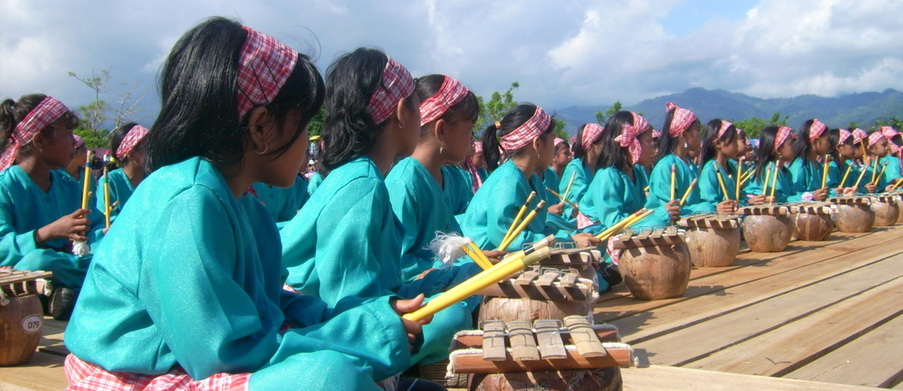
Indonesia is a nation full of beautiful and unique percussion instruments, but calong deserves special mention for its simplicity and design. The instrument, unique to the Mandar people of West Sulawesi, consists of a large coconut, hollowed out and with the top quarter sliced off to make something like a deep bowl. The coconut functions as the perfect resonator for four bamboo xylophone "keys", arranged from front to back, not left to right as you might see on a typical xylophone.

The instrument was traditionally played by farmers to take a break from the backbreaking labor in the heat of the Mandar sun. As such, it is in that special class of instruments that is played not for performance or ritual, but for the simple joy of making sound.

One thing I was happy to see when spending time in Mandar is that the instrument is being revitalized in a big way, blossoming from its humble roots as an obscure farmer's instrument to a unique symbol of Mandar arts and culture. Elementary schools and arts groups have begun to embrace the instrument for its simplicity and ease of playing, producing identically tuned instruments in mass numbers for schoolchildren to bang away on in synchronized rhythm. Some clever instrument makers have even created diatonic double-coconut calong, allowing Western and Indonesian national songs to be played.
Context:

After spending countless hours in Toraja and Enrekang sitting around living rooms and bamboo huts waiting for something to happen, I was pleasantly surprised by the speediness of my first experience in Mandar. Minutes after meeting my brief host and "fixer", the author and expert on Mandar culture Muhammad Ridwan Alimuddin, I was immediately shuttled off on the back of a motorbike to the house of Tombo Padhua, a local musician.

We sat down with Pak Tombo in the living room of his home, a wooden stilted house like many I had seen so far in South Sulawesi. After sitting down for a chat, Pak Tombo disappeared into the dark inner rooms of his home and returned moments later wearing a traditional Mandar headband (ikat kepala) and carrying his calong, festooned with puffballs of red fabric and a miniature Indonesian flag.

Pak Tombo sat down in a green plastic patio chair and placed the calong on a small table in front of him. Illuminated by the sunlight shining in through the woven bamboo walls of his home, he beat out a simple rhythmic pattern with drumstick-like beaters, the dry sound surprisingly loud with the help of the coconut resonator. As I watched, I couldn't stop smiling - barely thirty minutes in Tinambung, and already I was enjoying the humble sounds of Mandar folk music, beaming from the inside of a coconut.